
Shopvox has earned its reputation as the comprehensive solution for sign shop management. Thousands of sign businesses rely on it for quoting, production tracking, and customer management. It’s become something of an industry standard.
So why are sign shop owners searching for Shopvox alternatives?
The answer isn’t that Shopvox is bad software. It’s that the sign industry has diversified. A solo operator selling custom neon signs online has different needs than a 20-person shop producing channel letters for commercial clients. A business focused on ecommerce automation needs different tools than one handling complex, consultative projects.
This guide examines when Shopvox makes sense, when alternatives serve you better, and how to evaluate the options honestly. We’ll focus particularly on the distinction between comprehensive shop management and customer-facing ecommerce automation, two fundamentally different approaches that both fall under “sign shop software.”
What Is Shopvox and Who Uses It?
Shopvox is sign shop management software built specifically for the sign and graphics industry. It’s a comprehensive platform handling multiple business functions:
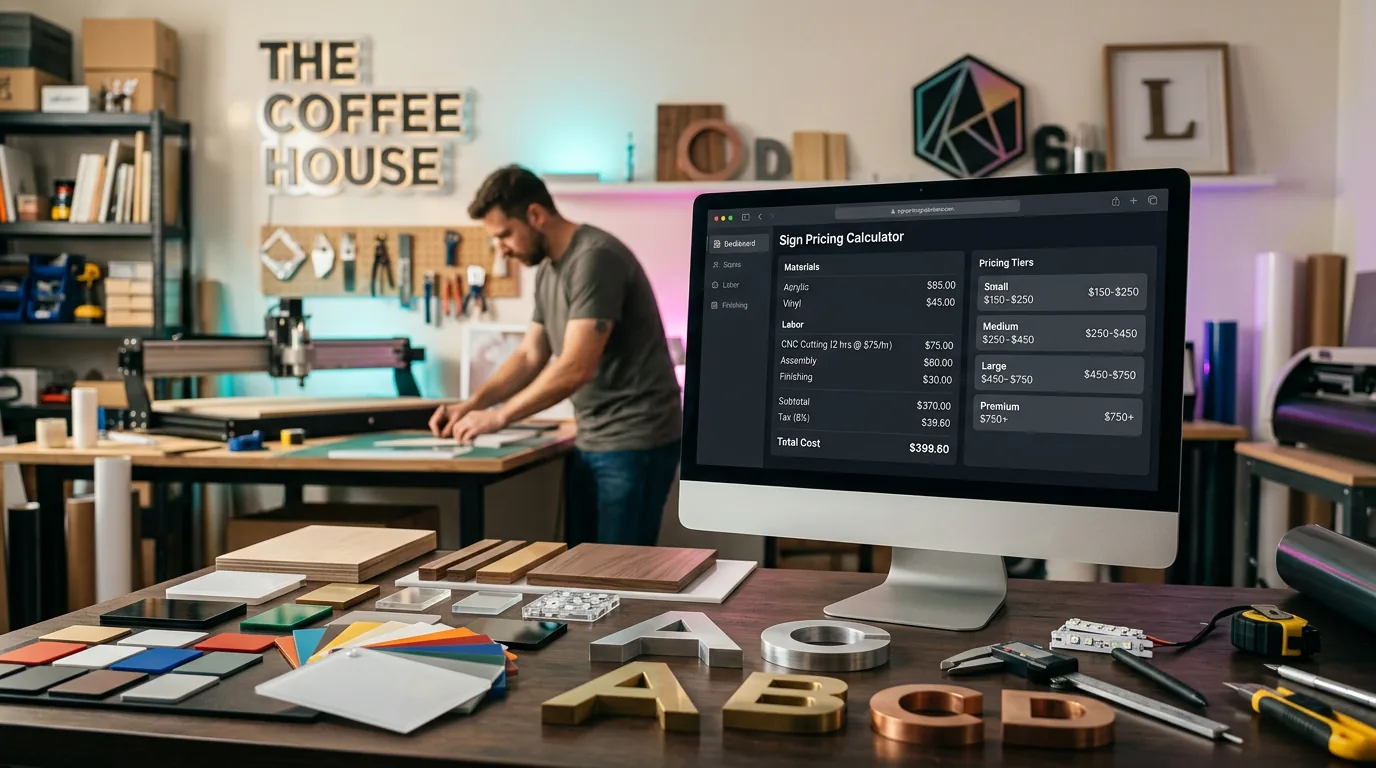
Quoting and estimation. Create detailed quotes with configured pricing for materials, labour, and markup. Send professional proposals to customers. Track quote status and follow up on outstanding enquiries.
Customer relationship management. Maintain customer records, communication history, and purchase patterns. Segment customers and track sales pipeline.
Production management. Schedule jobs across machines and personnel. Track production progress through stages. Monitor capacity and identify bottlenecks.
Job tracking. Follow orders from quote through production to delivery. Manage revisions and change orders. Track time and costs against estimates.
Invoicing and payments. Generate invoices, track payments, and integrate with accounting software.
Shopvox Strengths
The platform’s strengths are real:
Industry-specific design. Shopvox understands sign shop workflows. The pricing models, job stages, and terminology match how sign businesses actually operate. You’re not adapting generic software to your needs.
Comprehensive coverage. One platform handles most business functions. This eliminates data silos and reduces the need for multiple disconnected tools.
Established ecosystem. Years of development have created extensive features, integrations, and documentation. A large user community shares knowledge and best practices.
Production-focused. If production scheduling and job tracking are your primary challenges, Shopvox excels. The production dashboard provides visibility that simpler tools lack.
Typical Shopvox User Profile
Shopvox fits best for:
- Established sign shops with 5+ employees
- Businesses with dedicated sales and production roles
- Operations handling complex, consultative projects
- Shops prioritising production management over ecommerce
- Companies with budget for comprehensive software ($100+/month)
If this describes your business, Shopvox may be exactly right. The search for alternatives often comes from businesses that don’t fit this profile.
Why Sign Businesses Look for Alternatives
Understanding the reasons behind alternative searches helps identify what you actually need.
Cost Concerns
Shopvox pricing starts at $99/month for their Express plan and scales to $199+/month for the Pro plan with full functionality. For established shops with significant revenue, this represents a reasonable investment in operational efficiency.
For smaller operations, the maths looks different. A solo operator doing $5,000/month in revenue might find $200/month for software represents 4% of gross revenue before other costs. At that scale, simpler tools serving core needs offer better ROI.
The pricing isn’t “expensive” objectively. It’s about whether the features justify the cost for your specific situation. If you’re using 20% of Shopvox capabilities, you’re overpaying. If you’re using 80%, it’s good value.
Learning Curve and Implementation
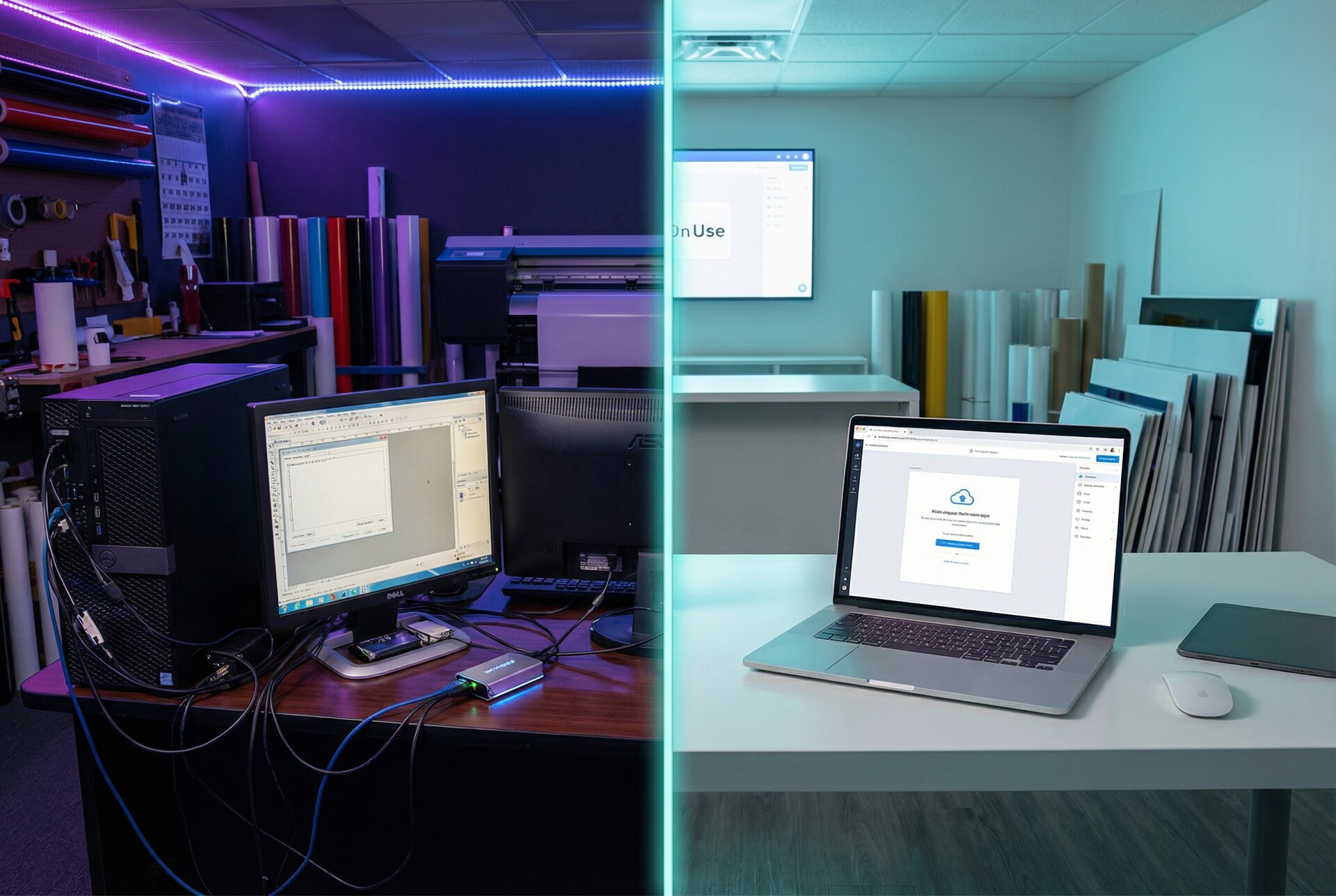
Comprehensive software requires comprehensive setup. Shopvox users report weeks to months of configuration before the system runs smoothly. Pricing templates, job stages, user permissions, integrations, all need attention.
For shops with dedicated admin staff or willingness to invest setup time, this is manageable. For owner-operators juggling production, sales, and operations, extensive setup time is a real cost.
Some businesses want software that works well within hours, not weeks. They’ll trade features for simplicity.
Ecommerce Focus vs Internal Management
This is the fundamental distinction many searchers haven’t clearly articulated.
Shopvox focuses on internal management. Your team creates quotes. Customers receive PDFs via email. Approved quotes become jobs. Production schedules internally. This workflow assumes human involvement at most stages.
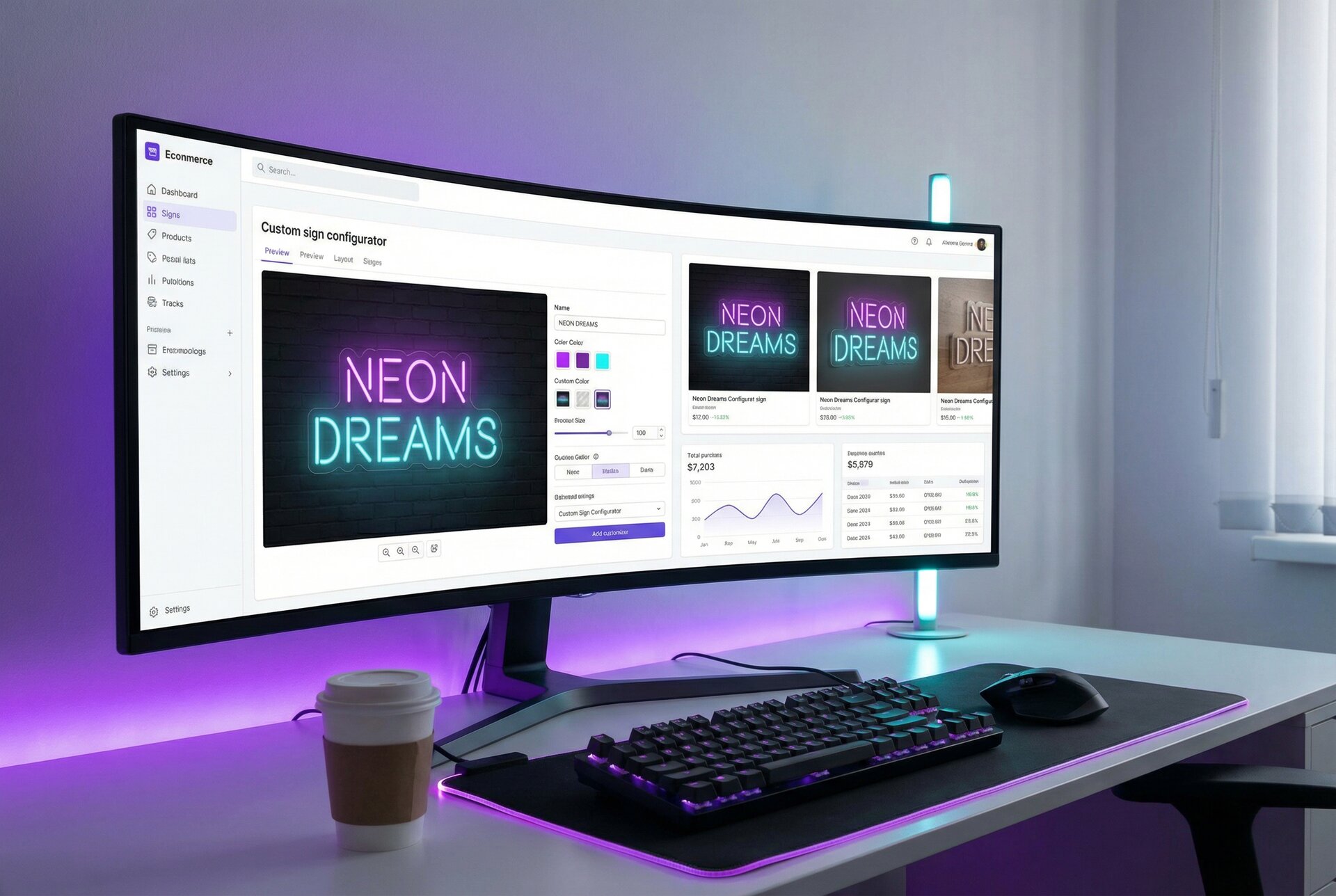
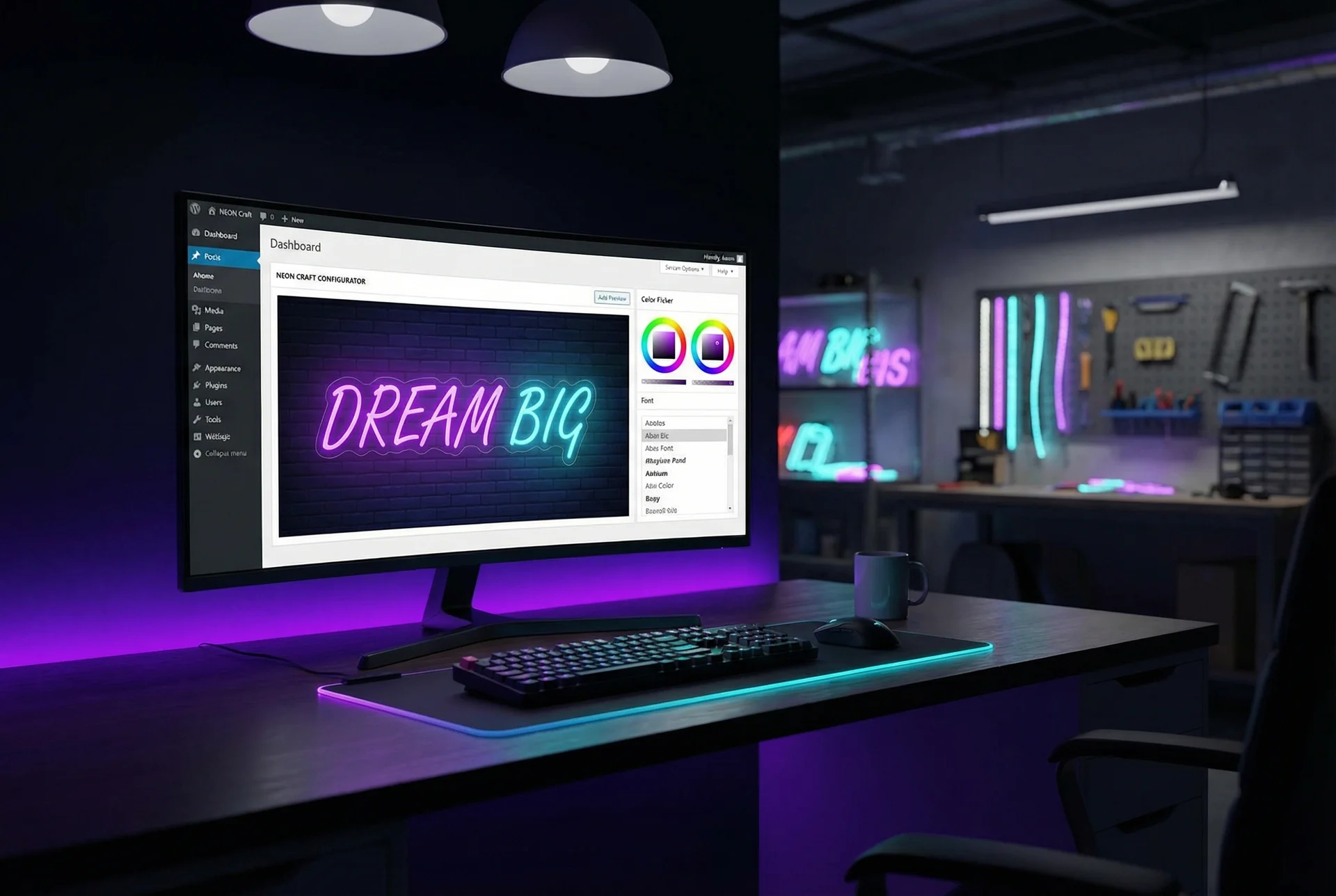
Ecommerce-focused tools automate the customer interface. Customers design signs themselves. They see pricing in real-time. They add to cart and checkout without waiting for quotes. Orders arrive complete with specifications and production files.
These approaches serve different sales models:
- Phone and email enquiries with consultation → Shopvox-style internal quoting
- Website visitors wanting instant pricing → Ecommerce-style customer automation
Many sign businesses have both sales channels. The search for “Shopvox alternatives” often stems from realising they need customer-facing automation that Shopvox doesn’t emphasise, not necessarily replacement of internal management.
Feature Fit
Comprehensive doesn’t mean universal. Shopvox includes features for scenarios that may not apply to your business:
- Multi-location operations
- Large production teams with scheduling needs
- Detailed inventory management
- Complex approval workflows
If your operation is simpler, these features add complexity without benefit. You might prefer focused tools that do exactly what you need without the overhead.
Conversely, Shopvox may lack specific capabilities you need. Real-time customer-facing pricing, native Shopify integration, or AI-powered design tools might require supplementary solutions regardless.
Sign Customiser vs Shopvox: Different Tools for Different Problems
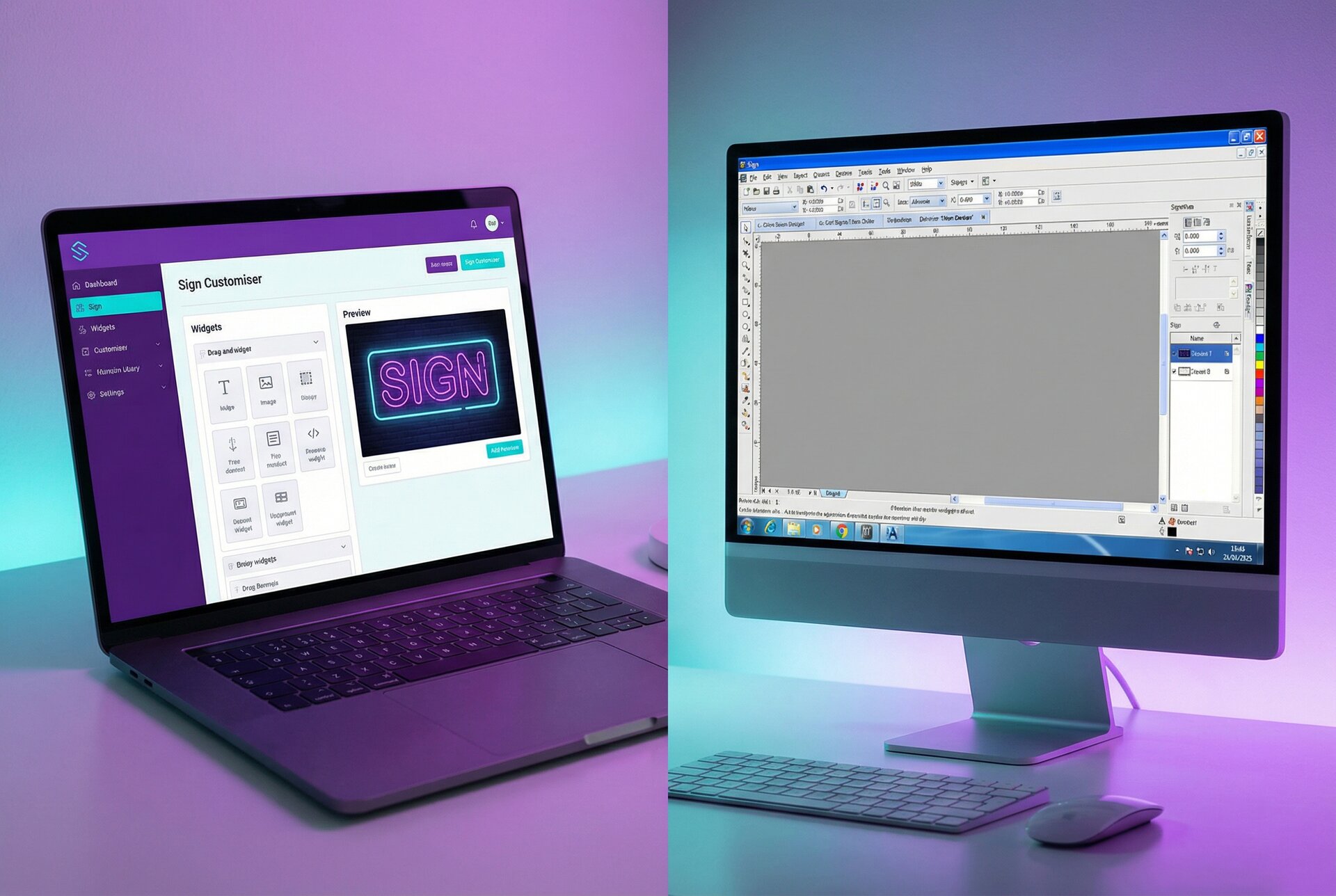
Sign Customiser isn’t a Shopvox clone at a lower price. It’s a fundamentally different tool solving different problems.
Core Philosophy Difference
Shopvox philosophy: Bring customers into your internal workflow. They request quotes, you respond, they approve, you produce.
Sign Customiser philosophy: Give customers tools to help themselves. They design, they see pricing, they order. You receive complete orders.
Neither approach is universally better. The right choice depends on your sales model and customer expectations.
Feature Comparison
| Capability | Sign Customiser | Shopvox |
|---|---|---|
| Customer-facing design tool | Yes (core feature) | Limited |
| Real-time pricing for customers | Yes | No (quote-based) |
| Internal quote generation | No | Yes |
| Production scheduling | No | Yes |
| Job tracking | No | Yes |
| Native Shopify integration | Yes | Add-on/limited |
| WooCommerce support | Yes (embed) | Limited |
| Invoicing | Via ecommerce | Built-in |
| CRM features | No | Yes |
| AI design assistance | Yes | No |
| Webhook automation | Yes | Yes |
| Starting price | $29/month (volume-based) | $99/month (Express) |
The table reveals complementary strengths rather than direct competition. Sign Customiser excels at customer-facing automation. Shopvox excels at internal management.
Pricing Model Approach
Both handle the complexity of sign pricing, but from different directions.
Shopvox pricing: Configure detailed pricing rules. Staff apply them when generating quotes. Customers see the final number after human calculation.
Sign Customiser pricing: Configure pricing rules that execute in real-time. Customers see prices update as they design. No staff involvement for standard products.
Sign Customiser supports multiple pricing models:
- Fixed width pricing: Character counts within size tiers
- Material length pricing: Precise calculations based on font path complexity
- Frame-fit pricing: Area-based calculations for backed signs
- Per-letter pricing: Individual letter costs with size variations
For detailed comparison of estimating approaches, see our sign estimating software guide.
Integration Capabilities
Shopvox integrations: QuickBooks, Xero, various payment processors, Zapier connections, API access. Focused on connecting with business operations tools.
Sign Customiser integrations: Native Shopify integration, WooCommerce embedding, webhook subscriptions for real-time data flow, API access. Focused on connecting with ecommerce and automation.
If your business centres on Shopify, Sign Customiser’s native app provides deeper integration than Shopvox can offer. If your business centres on internal operations with accounting integration, Shopvox connects more directly.
When Each Makes Sense
Choose Sign Customiser when:
- Most customers find you online and want instant pricing
- You sell through Shopify, WooCommerce, or similar platforms
- Standard products dominate your product mix
- You want to automate quote-to-order entirely
- Your team is small and time is scarce
Choose Shopvox when:
- Custom, consultative projects dominate your business
- You have dedicated sales staff for quote handling
- Production scheduling across team members is a priority
- You need comprehensive job tracking and costing
- You want one platform for most business functions
Use both when:
- You have distinct sales channels (online vs consultative)
- Standard products sell online while custom work needs quotes
- You want customer-facing automation feeding internal production management
Complementary Usage Example
A typical configuration using both tools:
- Customer visits website, designs a standard neon sign in Sign Customiser
- Customer sees real-time pricing, adds to cart, completes checkout
- Order arrives with specifications and production files via Sign Customiser
- Webhook triggers notification to production team
- Team creates job in Shopvox for production tracking
- Shopvox manages scheduling, progress tracking, and job costing
- Meanwhile, complex commercial enquiries come through traditional channels
- Shopvox handles quotes, approval, and production for these projects
This hybrid approach captures the strengths of both tools. Online sales automate completely. Complex work gets the attention it requires.
Other Shopvox Alternatives to Consider
Sign Customiser isn’t the only alternative, and different alternatives serve different needs.
SignTracker
What it is: Sign-specific quoting and job management software, simpler than Shopvox.
Best for: Small to mid-size sign shops wanting sign-specific features without enterprise complexity.
Strengths:
- Purpose-built for sign shops
- Quicker setup than Shopvox
- Solid mobile app for on-site quoting
- Reasonable pricing ($29-79/month)
Limitations:
- Fewer features than Shopvox
- No customer-facing pricing
- Limited ecommerce integration
Compared to Shopvox: Simpler, cheaper, faster to implement. Good for shops finding Shopvox overwhelming but wanting sign-specific management tools.
For more detail, see the SignTracker section in our sign shop management software guide.
Cyrious Software (Control)
What it is: Enterprise-grade sign shop management for large operations.
Best for: Sign companies with $1M+ revenue needing comprehensive ERP-style management.
Strengths:
- Handles complex, multi-step production
- Strong inventory and purchasing management
- Detailed job costing
- Scales for large operations
Limitations:
- Significant investment in money and time
- Overkill for smaller shops
- Dated interface
- Steep learning curve
Compared to Shopvox: More powerful but more demanding. Suitable for larger operations finding Shopvox insufficient at scale.
Estimate Rocket
What it is: General proposal and estimation software adaptable to sign work.
Best for: Sign businesses doing primarily installation work or simple projects.
Strengths:
- Clean, modern interface
- Fast proposal generation
- Reasonable pricing
- Good mobile experience
Limitations:
- Not sign-industry specific
- No sign-specific pricing models
- Limited production tracking
Compared to Shopvox: Simpler and cheaper, but generic. Works for basic estimation needs without sign-specific requirements.
Comparison Summary
| Alternative | Best For | Starting Price | Sign-Specific |
|---|---|---|---|
| Sign Customiser | Online sales automation | $29/month | Yes |
| SignTracker | Simple sign shop management | $29/month | Yes |
| Cyrious Control | Large sign operations | Contact | Yes |
| Estimate Rocket | Basic service quoting | $19/month | No |
When Shopvox Is Still the Right Choice
Balance requires acknowledging where Shopvox excels. Don’t switch for the wrong reasons.
Complex Production Environment
If you’re scheduling 10+ production jobs across multiple machines and team members daily, Shopvox’s production management becomes essential. Simpler tools lack the scheduling sophistication for this complexity.
The visual production dashboard showing job status, machine allocation, and capacity helps optimise throughput. You can’t replicate this with spreadsheets or basic tools without significant friction.
Consultative Sales Process
Some sign businesses thrive on the consultative approach. Customers want expert guidance. They expect human interaction before committing to significant purchases. The quote-and-approve process builds relationships.
If your average order value is $5,000+ and customers expect dedicated attention, the human-in-the-loop model isn’t a bug, it’s a feature. Shopvox supports this workflow elegantly.
Full Business Visibility
Shopvox’s comprehensiveness becomes valuable when you need unified reporting across sales, production, and finance. Seeing job profitability, customer lifetime value, and production efficiency from one dashboard enables management decisions that disconnected tools make difficult.
For shops scaling beyond owner-operator to professional management, this visibility justifies the investment.
Established Workflow
If Shopvox already runs your business smoothly, switching costs are real. Reconfiguring pricing, retraining staff, and risking disruption during transition have tangible costs.
The question isn’t “is there a better tool?” but “would switching create enough value to justify the disruption?” For shops with working Shopvox implementations, often the answer is no.
When to Switch: Making the Decision
If you’re actively evaluating alternatives, here’s a framework for deciding.
Signs You’ve Outgrown Shopvox
You’re paying for unused features. If your subscription includes production scheduling but you’re a solo operation, invoicing but you use Xero, CRM but you track customers elsewhere, you’re funding functionality that doesn’t serve you.
Online sales dominate but require manual handling. Each web enquiry triggers the same quote-preparation process. Customers wait for pricing. Some buy from faster competitors. Automation would capture these sales with zero marginal effort.
Setup never completed. You’re still using basic features after months. Full implementation keeps getting deferred. The software’s potential never realised.
Mobile access frustrates. Your work happens away from desktop. Shopvox’s mobile experience doesn’t meet your needs.
Signs You Should Stay
Production management drives value. The scheduling dashboard saves hours weekly. Job tracking catches problems early. Production visibility enables optimisation.
Custom work dominates. Most orders require consultation, custom specifications, and quote approval. Customer-facing automation wouldn’t capture your typical sale.
Your team knows the system. Staff are proficient. Processes are documented. Training investment would be lost.
Comprehensive reporting matters. Unified reporting across functions drives management decisions. Breaking into separate tools would fragment visibility.
Hybrid Consideration
Before switching entirely, consider whether complementary tools address your pain points without disruption.
If the issue is “I can’t capture online sales efficiently,” adding Sign Customiser for ecommerce while keeping Shopvox for custom work might solve it.
If the issue is “Shopvox is overkill for my operation,” switching to SignTracker or a simpler alternative makes sense.
If the issue is “I need enterprise features Shopvox lacks,” evaluating Cyrious or similar enterprise tools is appropriate.
Migration Considerations
If you decide to switch, plan carefully.
Data to Export
Essential:
- Customer contact information
- Product/pricing configurations (as reference)
- Outstanding quotes and orders
- Communication history with active customers
If possible:
- Historical order data for reference
- Job profitability records
- Supplier and material information
Rebuilding Pricing
The most time-consuming aspect of migration is recreating pricing logic. Shopvox pricing templates don’t export directly to other systems.
Document your pricing rules thoroughly before switching:
- Base prices by product type
- Size tier breakpoints
- Material multipliers
- Labour rates
- Markup percentages
This documentation becomes the specification for configuring the new system.
Timeline Expectations
Simple transition (e.g., to SignTracker): 2-3 weeks
- Export data, configure basics, test, switch
Capability addition (e.g., adding Sign Customiser): 1-2 weeks
- Configure products, integrate, test, launch
Full replacement with different workflow: 4-6 weeks
- Configure completely, train staff, parallel operation, verify, switch
Maintaining Business Continuity
Run parallel systems during transition. New orders go through the new system; existing commitments complete through the old one. Only shut down the legacy system when confident in the replacement.
Communicate changes to customers where relevant. If they’re used to quote PDFs and will now see online configurators, brief explanation prevents confusion.
Getting Started with Sign Customiser
If customer-facing ecommerce automation addresses your needs, here’s how to evaluate Sign Customiser.
Free Trial Exploration
Sign Customiser offers trial access to explore capabilities. During evaluation:
- Configure one product completely with your actual pricing
- Test the customer experience by designing and ordering
- Verify pricing accuracy against your current calculations
- Check Shopify/WooCommerce integration if relevant
- Explore the admin interface for ongoing management
Implementation Path
Week 1: Configure 2-3 core products with complete pricing Week 2: Integrate with your ecommerce platform, test order flow Week 3: Soft launch with limited promotion, verify everything works Week 4: Full launch for online products
This timeline assumes focused effort. Fitting around existing responsibilities may extend it.
Combining with Existing Tools
If keeping Shopvox for internal management, plan the integration:
- How do online orders from Sign Customiser become Shopvox jobs?
- Do you use webhooks for automatic notification, or manual transfer?
- Which system is the source of truth for each data type?
Clear boundaries prevent confusion and data inconsistency.
Resources
Product information: Sign Customiser features Pricing details: Plans and pricing Shopify specifics: Shopify integration guide Automation capabilities: How to automate your sign business Broader comparison: Sign shop management software guide
Conclusion
The search for a Shopvox alternative often reflects evolving business needs rather than Shopvox deficiency. As sign businesses diversify, software needs diversify too.
For shops finding Shopvox more than they need, simpler management tools like SignTracker offer focused functionality at lower cost. For shops needing customer-facing ecommerce automation, Sign Customiser provides capabilities Shopvox doesn’t emphasise. For growing operations, enterprise tools like Cyrious offer depth Shopvox can’t match.
The right choice depends on your business model, sales channels, team size, and growth plans. Generic recommendations fail because sign businesses vary enormously.
Ask the specific questions:
- Where do most customers find you?
- How do they expect to get pricing?
- What creates the most friction in your current process?
- What would you do with hours saved through automation?
The answers point toward the right tools. Sometimes that’s Shopvox. Sometimes it’s an alternative. Often it’s a combination serving different needs.
Whatever you choose, the goal remains the same: spend less time on administrative tasks, more time on work that builds your business. The tools should serve that goal, not become goals themselves.
Ready to explore customer-facing automation for your sign business? See Sign Customiser’s features and pricing, or start with our guide on automating your sign business for the complete picture.