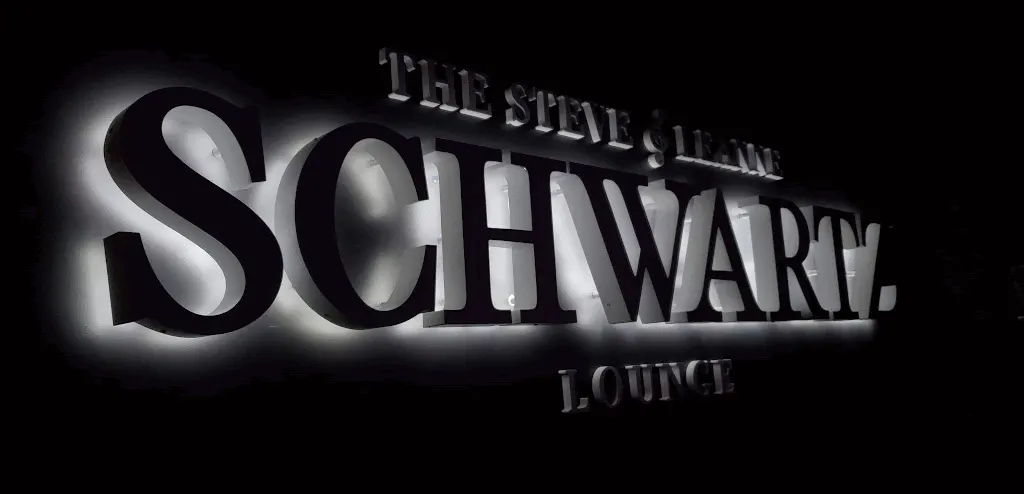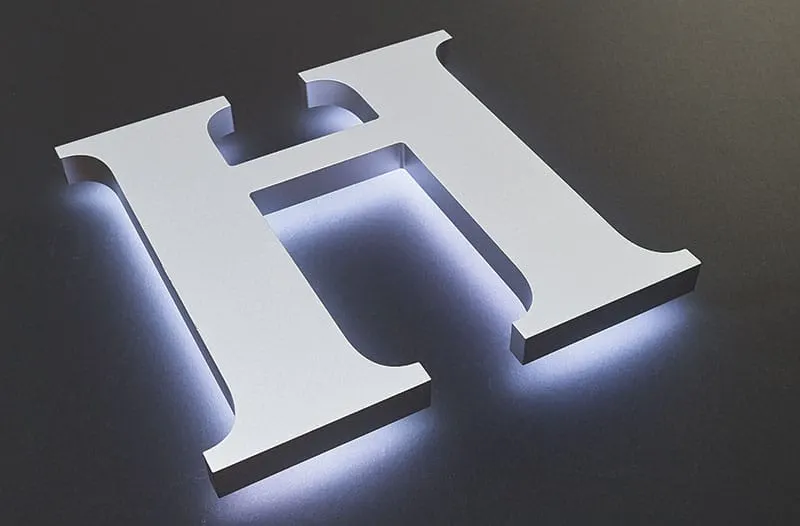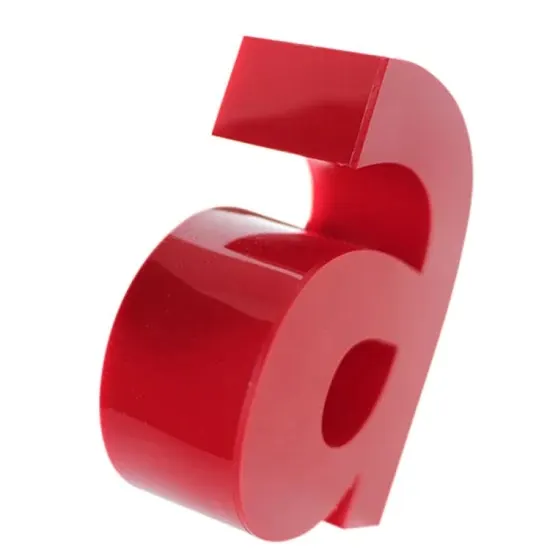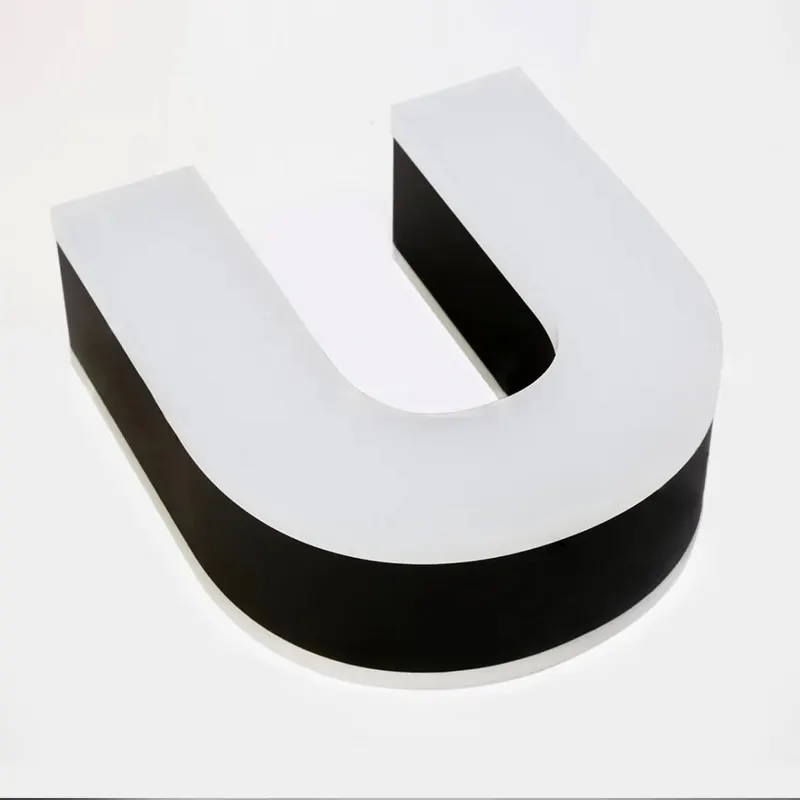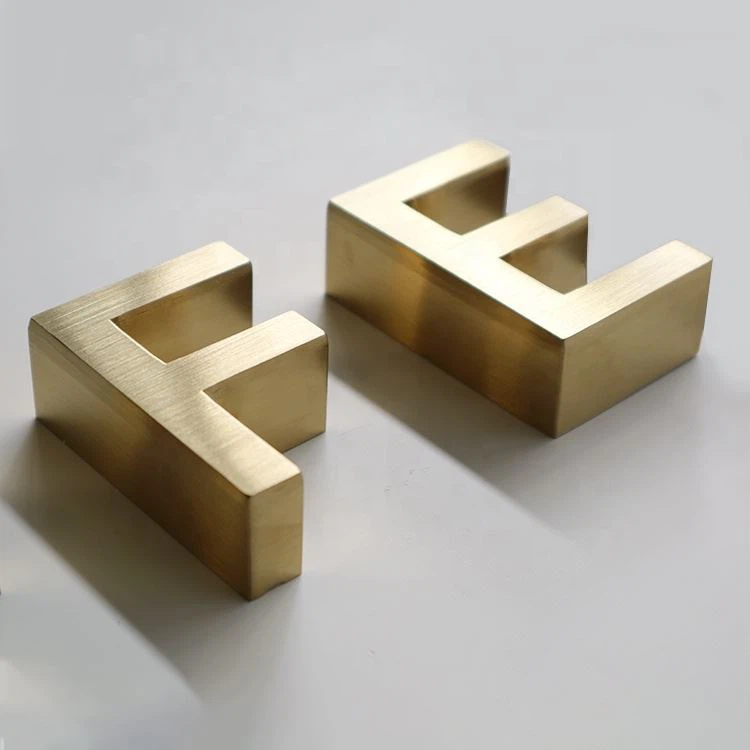
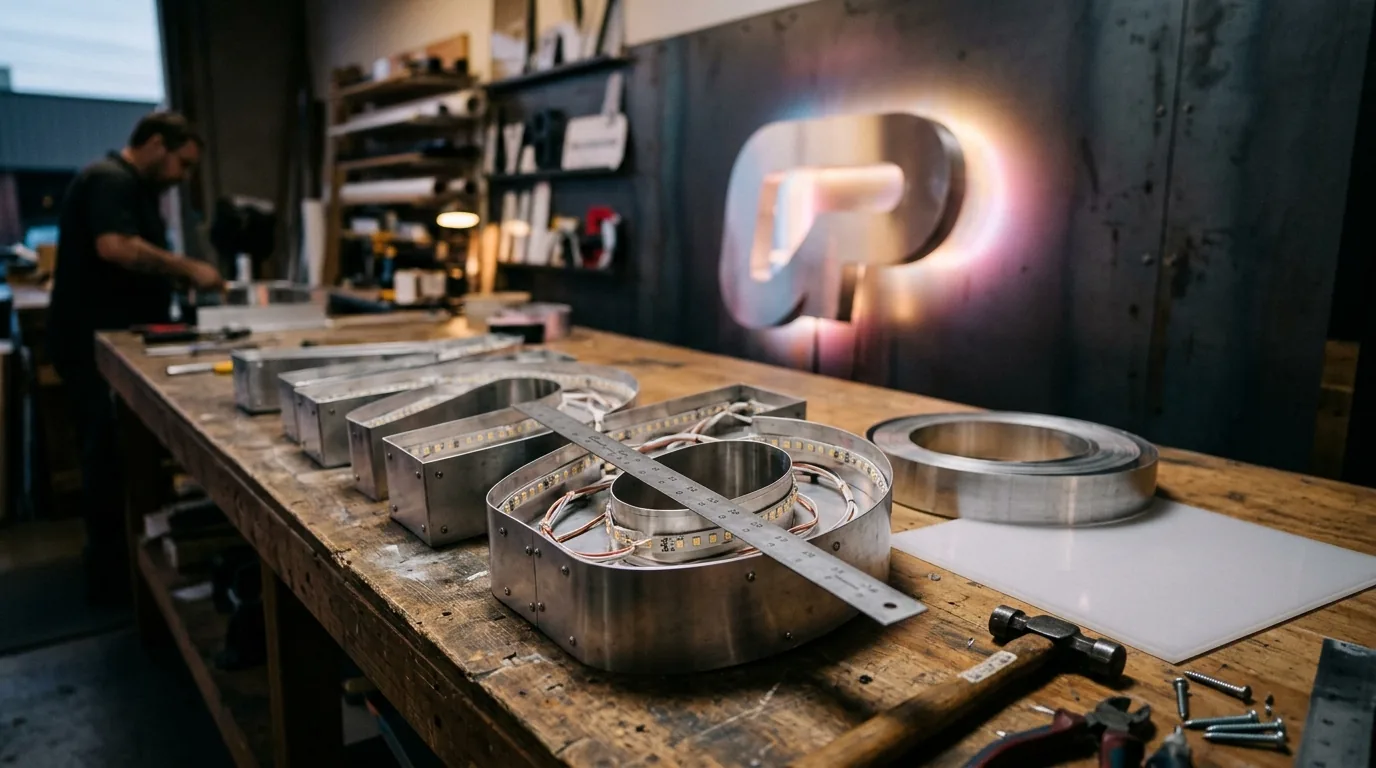
Channel letter signs are three-dimensional letters, each built as its own box with a face, sides called returns and usually a back, and LEDs inside when the letter is lit. The three main types are front-lit (the face glows), halo-lit or reverse-lit (the light washes the wall behind the letter) and combination (both).
Many sign shops price them with a rate per inch of letter height, multiplied by the number of letters. Others publish a price list per letter at each height, and local installers often quote the whole installed job.
This guide is for sign shops that make or resell channel letters and want to sell them on their own website. It covers the types, how the letters are built, what published prices look like, why one rate per inch cannot fit every letter height, and how to turn your price list into a live online quote. If you are buying one sign for your business, the types and cost sections will still help you compare quotes.
What channel letter signs are
The International Sign Association’s glossary defines a channel letter as “a three-dimensional letter that may include a light source”. Each letter is fabricated on its own. The side of the letter is the return and the front is the face. Lit letters usually have a back, so each letter is a closed box that holds its LEDs and wiring. ISA calls that shape a pan channel letter, “constructed with four sides—a face, sidewalls and a back”.
That build is what makes channel letters harder to price than a printed panel. Each letter is a small fabricated product, made to the customer’s font and height, then wired and mounted on the building. The cost depends on how many letters there are, how tall they are, how they are lit and how they are mounted.
Types of channel letter signs
Start a quote with the lighting, because the lighting decides the face, the back and the mounting.
| Type | How it is lit | Face | Back | Where it fits |
|---|---|---|---|---|
| Front-lit (face-lit) | LEDs shine out through the face | Translucent acrylic, held by a trim cap | Closed, usually aluminium composite (ACM) or aluminium | Storefronts that must read from the road at night |
| Halo-lit (reverse-lit) | LEDs shine backwards onto the wall | Solid, usually metal | Open or clear polycarbonate | Offices, hotels and shops that want a softer look |
| Combination (dual-lit) | Face and halo together | Translucent | Clear | Brands that want the most light |
| Open-face | The light source shows | None, or a clear guard | Closed | Exposed-LED and retro looks |
| Non-illuminated | No lighting | Aluminium or another material | Metal or acrylic | Daytime and interior signs |
ISA’s glossary backs the first two rows. A front lighted letter is “an illuminated letter with a translucent face; typically used with channel letters”. A backlighted letter is “a channel letter, with an open or translucent back, that is illuminated. Light is directed against a surface behind the letter, producing a halo effect.” ISA also lists the reverse channel letter, mounted away from the wall to form a halo, and the open channel letter, which “has no face, though a clear face may be used to protect internal components”.
For the selling points of the halo style, see 8 benefits of halo-lit channel letters. If you make the letters yourself, the beginner’s guide to making channel letter signs walks through the fabrication.
How channel letters are built
The parts are broadly the same from shop to shop, though trimless letters have no trim cap. The specification changes with the letter height and the lighting.
| Part | Typical specification | How it moves the price |
|---|---|---|
| Returns (sides) | Aluminium coil, .040 or .063 inch thick, 3 to 5 inches deep | Length grows with the letter height and the font outline |
| Face | 3/16 inch translucent acrylic on front-lit letters; solid on halo letters | Area grows with the square of the height |
| Trim cap | 3/4 or 1 inch, holds the acrylic face | Length grows with the outline; trimless letters skip it |
| Back | ACM or aluminium on front-lit letters; 3/16 inch clear polycarbonate on halo letters | Halo backs cost more and need standoffs |
| Lighting | LED modules and a power supply | Taller letters take more modules; a sign needs a power supply |
| Mounting | Flush (direct), raceway, wireway or backer panel | Raceways and backers add parts and labour |
These are trade figures, not a standard. SignLeaders’ channel letter details page lists 3 to 5 inch deep returns in .040 or .063 inch coil, 3/16 inch acrylic faces and 3/4 or 1 inch trim cap. Lee’s Signs (19 March 2026) gives a 3/16 inch clear polycarbonate back for halo letters and says halo letters “must be mounted 1.5″–2″ away from the wall surface” so the light can spread. Lit letters have a minimum height too. The Sign Chef sets its minimum at eight inches, because anything smaller cannot fit the LEDs.
Mounting changes the job as much as the letters do. Flush-mounted letters go on the wall one by one, each with its own holes and wiring. A raceway is a metal box behind the letters that holds the power supply and wiring, so the wall takes fewer holes. A backer panel carries the whole set on one board.
Electrical rules in the US
Lit channel letters are electric signs. UL 48 is the UL standard for them, and it covers “all electric signs, art forms and outline lighting for use in accordance with the National Electrical Code, NFPA 70”. Mike Holt’s summary of the code’s sign rules in EC&M says that “all electric signs, section signs, and outline lighting must be listed”. The same article says the disconnect must be within sight of the sign, which the code defines as “visible and not more than 50 ft distant”. The summary dates from 2013, so check the code edition your inspector enforces. For an online quote, the listed sign, the disconnect and any permit the city requires are part of the installed price, even when the customer only sees letters on a screen.
How sign shops price channel letters
Three methods come up again and again. A shop can build its price list with one and check it against another.
1. Per inch of letter height. Ascent Equipment, which sells channel letter machinery, calls this “the inch rule” in its 2026 pricing guide: “a dollar amount per vertical inch of letter height, multiplied by the number of characters”. Its worked example is 12 letters, 18 inches tall, at $22 an inch, which comes to $4,752. It puts fabrication-only rates at $12 to $18 an inch for standard front-lit aluminium, $14 to $20 for trimless, $16 to $22 for reverse halo and $25 to $40 for stainless steel, plus $2 to $5 an inch for painted custom colours. In a 2025 thread on the Signs101 forum, one shop said it uses $19 a vertical inch for remote channel letters, $21 for letters on a raceway and $22 for reverse channel. Another replied that cost per upright inch “is not the only way but is a very common way to price channel letters for wholesale channel letter fabricators”.
2. Per letter at each height. Online sellers publish a price per letter for each height and style. 42Fab’s channel letter deposit page says its letters are “generally priced between $75 and $150 per letter depending on size and complexity of font, with a minimum 6 letters”, with lighting at about $20 a letter in single colours and $35 for colour-changing. StorefrontSignOnline’s channel letter cost page (updated 11 October 2026) starts at $146.52 for one 8-inch front-lit letter and lists each style at heights up to 36 inches.
3. Per installed job. Local sign companies often quote the whole job, with the letters, raceway and installation in one price. Lee’s Signs says a typical front-lit storefront set of 8 to 12 letters on a raceway runs $3,000 to $6,000, and a comparable combination set $5,000 to $10,000 or more. It is the hardest price to put on a website, because the site decides it.
A per-letter price list is a per-inch rate worked out in advance, and it suits an online store better. A customer understands “this letter, this tall, costs this much”, and you still set each height from your own per-inch costs.
The per-inch rate is not flat
A single per-inch rate hides how prices really move. Divide StorefrontSignOnline’s front-lit price at each height by the height, and the rate per inch falls, then nearly doubles.
| Letter height | Front-lit, per letter | Front-lit, per inch | Halo-lit, per letter | Halo-lit, per inch |
|---|---|---|---|---|
| 8 in | $146.52 | $18.32 | $316.80 | $39.60 |
| 12 in | $176.22 | $14.69 | $392.04 | $32.67 |
| 15 in | $215.82 | $14.39 | $451.44 | $30.10 |
| 18 in | $279.18 | $15.51 | $558.36 | $31.02 |
| 24 in | $473.22 | $19.72 | $946.44 | $39.44 |
| 30 in | $748.44 | $24.95 | $1,496.88 | $49.90 |
| 36 in | $999.90 | $27.78 | $1,999.80 | $55.55 |
The per-inch rate is lowest at 15 inches ($14.39) and nearly twice that at 36 inches ($27.78). The page does not explain the curve, but the build suggests why. Every letter needs its returns bent, its face cut, its LEDs placed and its wiring run, however short it is, so small letters carry more fixed work per inch. Large letters grow faster than their height. A letter’s return length grows in step with its height, but its face area grows with the square of the height, so a 36-inch letter has about nine times the face of a 12-inch letter of the same shape. One flat rate per inch cannot match that curve. Set it for the middle heights and it under-prices the largest letters. Set it for the largest and it over-prices everything else.
Price each height on its own instead. Start from your per-inch cost at the height you sell most, then check the smallest and largest heights against your real material and labour. A per-letter price list by height lets you do exactly that.
Width matters as well. The inch rule charges the same for an “I” as for a “W”. In the same Signs101 thread, one poster points out “a major difference between an ‘I’ and an ‘&’ no matter what size they are”, and the shop that asked the question counts the letter “I” as two letters “to even things up”. If your fonts vary a lot in width, price by the outline of each letter. The worked example below shows how.
What halo lighting adds to the price
Halo letters cost more because the face is solid, the back is clear polycarbonate and every letter stands off the wall. How much more depends on the seller. Lee’s Signs says “Halo-lit typically costs 15%–30% more than front-lit”, and combination letters 25% to 40% more. StorefrontSignOnline charges twice its front-lit price for halo-lit letters at every height from 18 to 36 inches, and 2.1 to 2.2 times at 8 to 15 inches. It also lists a separate “back lit” style at 1.25 times its front-lit price from 8 to 30 inches, and 1.30 times at 36 inches.
Both can be right, because “halo-lit” covers different builds, from aluminium faces to welded stainless faces or returns. Price your halo option from your own build, not from a percentage you read, and show it as a separate choice so the customer sees the difference.
Fixed costs: power supplies, raceways and minimums
Some costs do not grow with the letter count. Charge them as fixed amounts, not inside the per-letter rate.
- Power supply. A lit sign needs one. StorefrontSignOnline charges $99.00 for its standard power supply.
- Raceway. StorefrontSignOnline charges $55.00 a foot. On an online quote, it is an option with its own price.
- Minimum order. 42Fab sets a six-letter minimum. A base price per sign does the same job without turning the order away, so a two-letter monogram still pays for its setup and power supply.
- Installation, permits and surveys. These depend on the site. Keep them out of the online price and quote them once you have seen the wall.
Worked example: a channel letter price list as an online quote
Here is how a sign shop could set up a channel letter price list in Sign Customiser. Sign Customiser has acrylic channel letter and metal channel letter customisers, and each one shows the customer a live preview and price as they design. Every price below is an example setting a sign shop might choose. None of it is Sign Customiser data.
Step 1: sell by letter height. In the Simple Letter model, each size has a fixed width or a fixed height. To sell by letter height, choose Fixed Height - Width scales dynamically. Sizes use your Store’s unit, inches or centimetres. This shop creates four sizes, at 8, 12, 18 and 24 inches.
Step 2: set a base price and a letter price for each size. Each size takes a Base Price for each line of text and a Letter Price for each letter, and spaces are not counted. The shop starts from $15 an inch, inside the front-lit range above, and adds $99 a line for the power supply and handling.
| Size (letter height) | Base Price (per line) | Letter Price | “BLUE OAK” (7 letters), front-lit |
|---|---|---|---|
| 8 in | $99 | $120 | $939 |
| 12 in | $99 | $180 | $1,359 |
| 18 in | $99 | $270 | $1,989 |
| 24 in | $99 | $360 | $2,619 |
Because each size has its own Letter Price, the shop can follow the curve. It can raise the 24-inch price above $360 to cover the extra face area, or lower the 8-inch price to win small jobs. If the first letters should cost more than the rest, Price by position sets a price for each letter position. Each font can also have its own pricing rule, so a script font that takes longer to bend costs more than a block font.
Step 3: make halo-lit a letter type with its own price. Front-lit and halo-lit become two letter types. On the halo-lit type, the shop sets a price multiplier of 1.25 with the Price Multiplier Target Letter Price Only, which covers the size’s base price and letter charges. “BLUE OAK” at 12 inches then costs ($99 + $1,260) × 1.25 = $1,698.75, against $1,359 front-lit. The customer sees the halo preview before they choose, and the price updates with the choice. Front-lit and back-lit channel letters shows how to switch on the face glow and the back-lit halo.
Step 4: price the parts customers can change. Each letter type has letter parts: Face / Front Lit, Side (the return), Trim and Back Lit. Face / Front Lit is always on, and you switch the other three on for each letter type. You set a price on each colour or material, as a flat amount or a multiplier, so a brushed stainless face can cost more than a standard acrylic one.
Step 5: add the raceway. In Sign Customiser, single and double raceways are backboard types, and each backboard can carry a fixed price, a multiplier or a price per square inch (or square centimetre) of the sign. With a $250 fixed price on the raceway, the halo-lit “BLUE OAK” comes to $1,948.75. Mountings, the hardware the customer picks to fix the sign, take a fixed price or a multiplier.
When letter width matters, use the Advanced Letter model with Letter Material Cost. It measures the outline of every letter and prices the material length, so fonts with longer outlines cost more and a “W” costs more than an “I” without any counting rules.
When the job needs a survey, turn on Quote Mode. It replaces add to cart with a quote form. The customer still designs the sign and sees the preview, and the request lands in your admin for review. The customer pays nothing at that stage, and sees no price unless you turn on Show suggested price.
In both cases, the size, colours and options the customer chose reach you with the order or the quote request, so nobody retypes the job from an email. The metal channel letter customiser and the acrylic channel letter customiser pages show what the customer sees.
What to show customers before they order
A customer who picks the wrong height will want a refund. Three things on the product page help.
- Height for the viewing distance. The free sign letter height calculator gives the minimum letter height for a viewing distance or a road speed. Link it next to your size choice.
- The finished size. Show the finished width and height before checkout, so the customer knows how big the sign will be on the wall.
- What the price includes. Say whether the price covers the power supply, the raceway, shipping and installation.
Before you publish the list, run each height’s costs through the sign pricing calculator, one height at a time, to check the margin. For the full method, with shop rate, markup and margin, see how to price signs.
Pricing mistakes to avoid
- One rate per inch for every height. It cannot fit both small and large letters. Price each height.
- Ignoring the font. A script with long strokes uses more return and trim than a block font of the same height.
- Hiding fixed costs in the letter rate. A two-letter order then loses money, and a twenty-letter order costs the customer too much.
- Guessing the halo price. Price it from your own build and show it as a separate choice.
- Putting installation in the online price. It depends on the wall, the permit and the electrics. Quote it separately.
Frequently asked questions
What are channel letter signs?
Channel letter signs are three-dimensional letters, each fabricated on its own with a face, sides called returns and usually a back. Lit letters hold LEDs inside. The International Sign Association defines a channel letter as “a three-dimensional letter that may include a light source”.
What are the types of channel letter signs?
The main types are front-lit, where the face glows; halo-lit or reverse-lit, where the light shines onto the wall behind a solid face; and combination, which does both. Open-face letters show the light source, and non-illuminated letters have no lighting.
How much do channel letter signs cost?
Published prices vary with height, style and what is included. On 6 November 2026, StorefrontSignOnline listed front-lit letters from $146.52 for one 8-inch letter to $999.90 for one 36-inch letter, the largest height in its price table. 42Fab says its letters are generally $75 to $150 each, with a six-letter minimum. Installed sets cost more: Lee’s Signs puts a typical front-lit set of 8 to 12 letters on a raceway at $3,000 to $6,000.
How do sign shops price channel letters?
Many shops use a rate per inch of letter height, multiplied by the number of letters. Others use a price list per letter at each height or quote the installed job. Ascent Equipment’s 2026 guide puts fabrication-only front-lit rates at $12 to $18 an inch. Some sellers charge fixed costs separately: StorefrontSignOnline prices its power supply and raceway on their own.
Do halo-lit channel letters cost more than front-lit?
Yes. Lee’s Signs says halo-lit letters typically cost 15% to 30% more than front-lit. Some online sellers charge much more: StorefrontSignOnline’s halo-lit letters cost twice its front-lit price at heights from 18 to 36 inches.
How small can channel letters be?
The Sign Chef sets its minimum for channel letters at eight inches tall, because anything smaller cannot fit the LEDs.
Can I sell channel letters online with a live price?
Yes. A sign customiser on your store lets the customer type their wording, pick a height, font, colours and lighting, and see the price before they order. In Sign Customiser, the Simple Letter model gives each letter height its own letter price. Quote Mode suits jobs that need checking first, such as installation, and hides the price unless you choose to show it.
Sources
- International Sign Association, Glossary of Sign Terms & Definitions
- UL Standards & Engagement, UL 48, Standard for Safety for Electric Signs (last revision 14 May 2025)
- Mike Holt, NEC Rules for Electric Signs and Outline Lighting, EC&M (2013)
- Signs101, Vertical Inch Channel Letter Pricing? (posts quoted from May and June 2025)
- Sign company pages named in the text, all read on 6 November 2026: StorefrontSignOnline, “Channel Letter Cost: Real Prices per Letter & Height (2026)”; 42Fab, “Channel Letter Sign - Deposit”; Ascent Equipment, “How to Price Channel Letters in 2026”; Lee’s Signs, “Front-Lit vs. Halo-Lit vs. Combination Channel Letters: Which Style Is Right for Your Business?”; SignLeaders, “Channel Letter Details”; The Sign Chef, “Channel Letters Signs”.